Wednesday, April 17, 2013

Machu Picchu

It's hard to believe that just this morning I was walking where Incas walked.

We're in Ollantaytambo (Oh-YAN-tie-tahm-bo) now, a small town just south of Aguas Calientes.  It's our first way point on the journey between Machu Picchu and Lima.  Tomorrow we'll go hiking here and then take a van to Cusco and an overnight bus to Arequipa.  It's a long way, but this experience has already been worth the trip.

Yesterday afternoon we took the train into Aguas Calientes, the closest town to Machu Picchu.  The train had a glass dome, so we were treated to an hour and a half of spectacular Andes mountain views.  The train was also fancy - there was a snack service like you'd have on an airplane ride, and the station had the cleanest bathrooms in South America.  If you've ever been to South America, you'll understand why this is a notable fact...

Aguas Calientes was pretty much what I expected it to be - a conglomeration of hotels, hostels and restaurants serving tourists on their way to Machu Picchu.  But for what it's worth, the prices aren't too steep, and most of the locals still speak mostly Spanish.  Our hotel turned out to be fantastic for the price we paid, and for dinner we found a nice restaurant where we tried ceviche, raw fish marinated in lemon juice and hot red pepper.  I'm not a huge fan (the texture is a little strange), but Tim and Kyle both loved it.

After dinner, we still had plenty of time to get our tickets for Machu Picchu and head to the only other local attraction - the hot springs!  Aguas Calientes isn't named Hot Waters for nothing.  The local access to the springs was quite a bargain - just $4 to soak in the several different pools.  Each one was a different temperature, so we found a comfortable one and sat for a couple of hours chatting with a group of Argentine women.  The guys did pretty well keeping up with conversation again!  I was proud of them.

However, we had to go to bed pretty early in preparation for today.  We woke up at 4:30 AM (the recommended hour), ate the breakfast the hotel graciously prepared at that ridiculous time, stowed our luggage and walked over to the bus station in the dark.  We had been planning to hike up to the ruins, but Tim's persistent cough was starting to get worse, so we decided to pay a bit extra to take the 15 minute bus ride to the top.  That turned out to be a good decision, since the early hour meant that hikers had to climb hundreds of stairs in the foggy morning darkness.  Plus, in the bus line we ran into two French guys we met at Tiwanaku!

We arrived at the entrance a minute or so after it opened, so we had prime access to the ruins.  As we entered, there was a fork in the path.  By chance, we chose the direction no one else picked, so for the first two hours, we barely saw another living soul.

Going to Machu Picchu is like walking into a myth.  For one thing, it's so foggy in the morning twilight that everything looks mysterious.  You can walk up to the edge of a stone platform, look off into the distance and see... nothing.  Just white mist.  It's so quiet that it's almost eerie. Without anyone else there, I could almost pretend I was an Inca.

We found a spot to watch the sunrise, and though it wasn't particularly brilliant or colorful, it was fantastic, because the sudden heat from the sun causes the fog to part and reveal the Andes and the river valley below.  We sat for several minutes in silence (except for the interruption of a guard who brusquely informed us that sitting on Inca walls is NOT allowed, and that we would have to stand if we wanted to see the sunrise).

Next, we decided to head uphill toward the temple sector to see the Templo de las Tres Ventanas and the views of the terraces on the other side of the mountain.  Here we had our first run-in with "ugly Americans" on the trip - a group of girls screaming and taking picture after picture of themselves jumping up in the air in front of the ruins.  Now, I know Machu Picchu is exciting, but if you ever get the chance to go, please don't be those people...

Anyway, the temples were great!  It was really interesting to see how the stonework changed over time.  Down below, the granite rocks were hugely varied in size from giant boulders to tiny chips used to fill in the gaps, while the temples at the top were constructed from finely hewn stone blocks that fit together perfectly with no mortar.  We saw stone archways and platforms that the Incas used to make astronomical observations.  The view was amazing, too.  Those potato farmers must have been so inspired by their surroundings.

After exploring the temples and other main square buildings, we took our first short hike out to the puente Inka (Inca bridge).  The views there were great, too, although quite distinct.  The jungle is denser there, and it looks out over sheer granite cliffs that are totally different from the green, pointy mountains I associate with the Andes.  The Inca bridge was amazing just because I can't believe it still exists - it's literally just a wooden board stretched across a terrifying gap in the rocks, with no handholds of any kind.  Needless to say, we did not cross it (you're not allowed to, anyway), but we did try our hardest to get our picture taken with it.  Unfortunately, some tourists cannot be coached to take a picture, no matter how hard you try.  :-)

Our next short hike took us all the way to the edge of the historical reserve to the puerta del sol (Sun Gate).  At least, it looked short on the map.  It really took us about an hour to walk up the hundreds of steps, and by this hour the sun and the humidity were teaming up to make a fierce heat.  We stopped for peanut butter sandwiches along the way and also to admire the views, which really looked like something from a postcard.  The Sun Gate was also interesting because it led to another path, which we followed for about half an hour, trying to see where we'd end up.  Eventually we ran into another group of hikers who informed us that we wouldn't end up anywhere - we'd found the Inca Trail!  Since we didn't have the permits, gear, or the four days needed to hike the trail, we headed back, but not before we saw an amazing rainforest butterfly!

By the time we returned to the main site, it was getting to be later in the afternoon and we were pretty tired.  However, we decided to keep trekking until we'd seen every part of the (really large, actually) ruin complex.  We walked to the Casa del Inka, where I learned something interesting.  I hadn't realized that most of the stone walls you see on postcards were just part of the original buildings.  Almost all of the structures in the area had thick, thatched roofs really similar to the ones we saw on Lake Titicaca.  I mean, it makes sense, of course, but I had never thought about it before.

When we had finally seen the whole complex, we were still hesitant to leave.  Machu Picchu is just so amazing!  I hope I'll be back someday, but who knows?  So we sat around for a bit, admiring the views, until we were too hot and sweaty to stay.  Then, we followed our original plan to hike down, trotting down several hundred steps and along the river back to Aguas Calientes.  There, we enjoyed a well-deserved pizza and some pisco sours, the national drink made from lime juice, egg whites, and pisco (grape brandy), before heading back to the hot springs for another soak.  What a day...

Friday, April 12, 2013

Lago Titicaca

The last few days have been among the most peaceful and inspiring in my life.  We've been traveling in and around Lake Titicaca, the giant freshwater lake that stretches across the border between Bolivia and Peru.  It's the highest navigable lake in the world, at 12,507 feet, and it has a beautiful panoramic view of the Andes mountains, although once you reach the center, you can just barely see them.

On Wednesday, we took two three-hour bus rides to cross from La Paz, Bolivia to Puno, Peru.  The Bolivian bus took us to the border, where we walked about 200 yards into Peru and went through customs before boarding a Peruvian bus.  Kind of an odd arrangement, but it was okay.

When we got to Puno, we planned to go to the Coca Museum, the Mirador, and a few other attractions.  However, we spent most of our day 1) getting lost and 2) trying to rescue Kyle's debit card from the depths of an ATM that ate it.  We did eventually recover the debit card and find ourselves, but we didn't have time for the mirador.  Luckily, the Coca Museum was open late, so we went there for an hour before dinner.  I learned a lot about coca.  For one thing, it's extremely nutritious.  If you eat it, it's higher in vitamins and minerals than vegetables like broccoli and spinach.  For another, it is extremely ancient.  Many pre-Inca artifacts have been found that show the practice of chewing coca leaves as far back as 8000 years ago.  There are pouches used for carrying the leaves, statues that show faces chewing coca, and even a 3000-year-old mummy with coca in its mouth (not located at the museum, unfortunately).  The Andean people believed that the use of coca was reserved especially for them, and that it would make the Spanish invaders sick.  They never got to test this theory much, though, because the Spaniards were more interested in destroying the leaves than chewing them.

After leaving the Coca Museum, we went to Balcones de Puno, a restaurant recommended in Kyle's guidebook, for dinner and a show.  I think that is the fanciest restaurant I have ever been in.  I ordered Alpaca steak stuffed with cheese and spinach covered in some sort of sauce called "terciopelo" (velvet).  It also came with mashed yucca and it was absolutely perfect.  Alpaca tastes a lot like beef, but more tender.  Yucca tastes a little bit like potato.  Our dinner came with entertainment in the form of a traditional Peruvian band complete with flutes and drums, and four traditional dancers who showed us dances as diverse as one about a shepherd and his sheep, and another about coquettish lovers.  It was a great introduction to Peru.

The next day, we left fairly early in the morning for our Lake Titicaca adventure.  We boarded a boat with 20 other passengers from all over the world, including Joe, from England, Tiina, from Finland, Yoshi and his tiny daughter from Japan, and Nicola, a Spanish teacher from France.  I loved the feeling of being on the boat with the wind in my hair and the bright, high-altitude sun (I put on sunscreen every hour, but Kyle foolishly decided he couldn't get any more burnt than he already was... false).  Our first stop was Uros, one of the famous floating islands.  Many hundreds of years ago, the people of the floating islands lived on the mainland.  However, threats from the neighboring tribes drove them into the lake itself, where they built themselves islands out of totora, a giant reed plant that grows in the lake.  They dig up big chucks of turf and lash them together with ropes, and then cover them with heaps and heaps of reeds.  They add more reeds each day to keep the islands intact.  They also use these amazingly versatile reeds to build houses, boats baskets, and even to eat!  We got to try some - it tastes like boring celery.  We took a ride on a reed boat and saw black ibises, native birds that the people of Uros use for their curative properties.  They believe that drinking the blood of an ibis can cure epilepsy.

After about an hour on Uros, we got back on the boat for another hour-and-a-half ride to Amantani, a natural island in the middle of the lake.  Upon our arrival, we were greeted by our "host moms" and walked across the island to the home where we would sleep.  Our "mom," Margarita, fed us a delicious traditional lunch of quinoa soup, fried cheese and vegetables. One interesting vegetable addition: okka, a tuber that tasted like a soft, slightly sweet potato.  After lunch, we walked to the community center to meet our tour group and go on a hike.

We started up the hill, passing rows and rows of uprooted potato fields (the harvest had just passed) and villagers going about their daily business, leading sheep around and carrying bags of vegetables up and down the island paths.  There are no roads on Amantani, making it the perfect refuge after the chaos of La Paz.  As we got higher, the view of Titicaca got better and better.  Eventually the path split in two directions, and half of us decided to climb Pachamama, (Earth Mother) the higher mountain while the other half headed up Pachatata (Earth Father).  I'm sure the other people had an equally wonderful time, but I think we made the right choice.


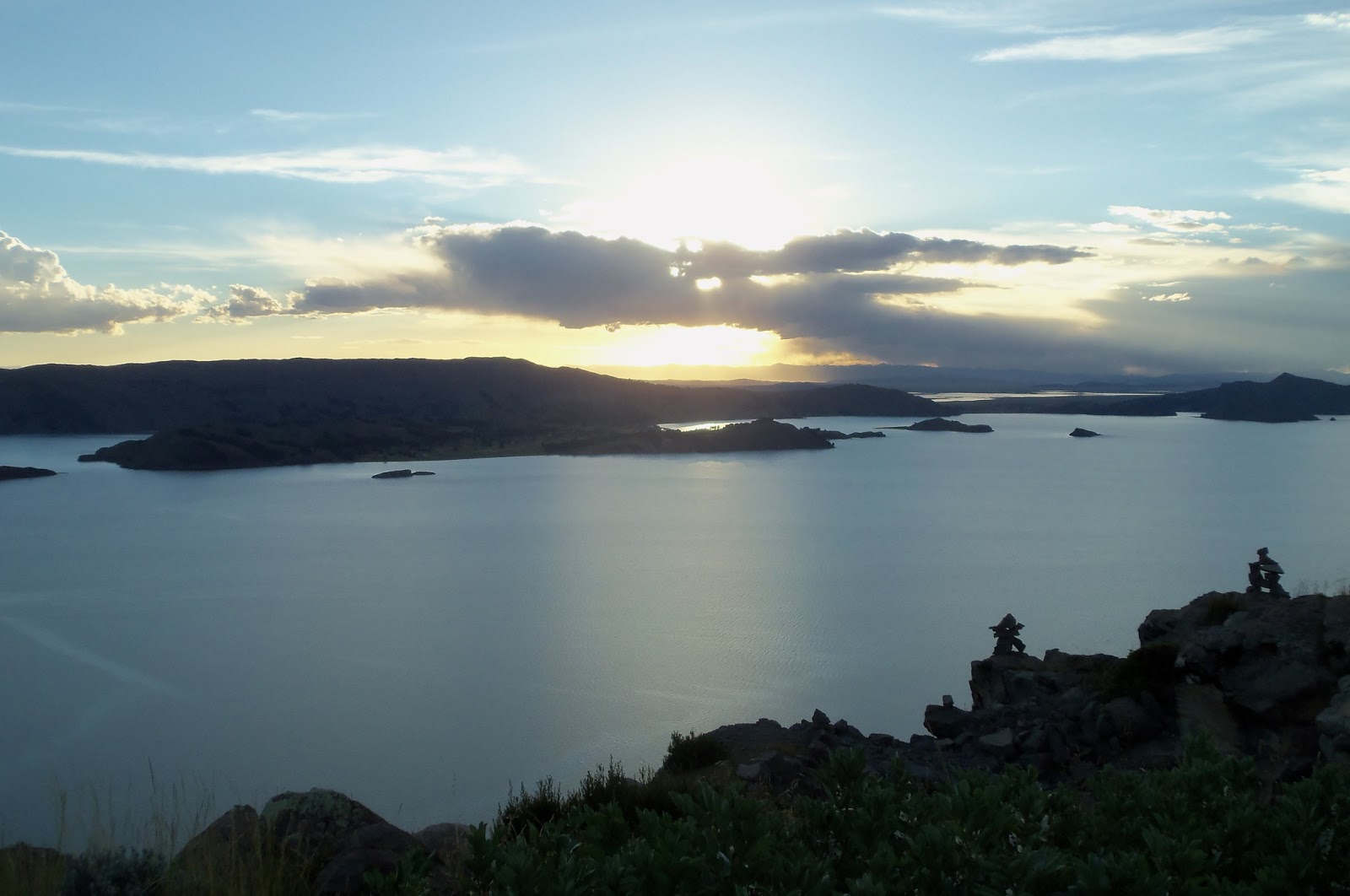
Sunset atop Pachamama was a spiritual experience.  The peace was absolute.  Neither pictures nor words can describe the feeling of pristine, panoramic beauty surrounding you.

After sunset, we walked down to Margarita's house for a light dinner of a million carbs (potatoes with rice, anyone?).  It was nice to get a chance to chat with her.  She said that she's been hosting travelers ever since her children grew up and left home, and that it's always a nice treat to have people come.  That made me feel a bit better about invading her house - apparently each host village on the island only gets tourists about 3-4 times/month because they rotate.  Thus, when there ARE tourists, it's party time!  Margarita brought out a large bundle of clothes to dress us up for the celebration.  The men got nice, easy-to-wear ponchos, while Tiina and I were fitted into a petticoat, two skirts, a blouse, a sash and a shawl.  I didn't have to worry about the chilly Lake Titicaca evening air!

The fiesta was a good time.  Kyle got the party started by dancing, and all the rest soon followed suit.  The music was a lot like Balcones de Puno's band, so dancing was a bit challenging - you couldn't do the standard gringo shuffle.  There was a lot of holding hands and dancing in a circle done by tourists and Amantanians alike.  I think the highlight of the night was watching Yoshi's little tiny daughter dance with everyone.  There wasn't much light in the room, but boy did her smile light everything up.

After the party, we were in for one more treat - because of the extreme altitude and near-perfect darkness, the stars on Amantani are like nowhere else in the world.

In the morning, our island adventure was almost done.  We breakfasted on pancakes (!) and gave Margarita her hostess gift of a bag of fruit and a "lucky" gold U.S. dollar.  I sincerely hope it does bring her luck; she was a wonderful host mom and made our stay very special.  Thanks, Margarita!

The very last stop on our tour was Taquile, an UNESCO world heritage site.  Taquile is well-known for its beauty, as well as for its interesting hats.  You see, on this island, a man's status is broadcast through his pointy, tasseled, knitted-alpaca hat.  As you get older and more respected, you get to add more colors to your hat, until finally you're an elder and you get the most decorative hat of all.  Pretty neat, huh?  However, Taquile's world heritage status means it's the most "touristy" of all the islands on Titicaca - some of the residents will sit around all day trying to get you to pay them to pose for a picture, which is a bit depressing, if you ask me.

We spent about two hours on Taquile, long enough to take a couple of short hikes to see the sapphire lake views.  It was also long enough to get a special Titicaca treat - trucha (trout)!  I've never been much of a fish person, but apparently that's because I've never had truly fresh fish before.  Now that I've tasted trucha frita, I'm a convert for life.  :-)

Wednesday, April 10, 2013

La Paz and La Nausea

Yesterday was the day we had planned to see most of La Paz.  Since I had spent a couple of weeks there, I led the boys around a bit.  Our first stop was el Jaen, a street with many colonial houses that have been transformed into cultural museums.  We visited the house of Pedro Domingo Murillo, a leader of the Bolivian independence movement in 1809, who was brutally executed by royalists.  We read a lot about that war and even saw the Declaration of Independence (it doesn't look or sound so different from ours).  We also learned that Bolivia used to extend all the way to the coast, back when Chile was a lot shorter.  Apparently, lost Bolivia its seaports to Chile and quite a bit of land to Paraguay, which the Bolivians say is the main reason for their stunted development as a nation.

Next, we went to the Museo de Instrumentos Musicales, a private museum that is so FUN!  They have an extensive collection of Bolivian musical instruments, from ancient stone flutes to antique 10-string guitars made of armadillos.

Ceci actually told me a legend about the armadillo guitars.  They are called kirkinchos.  Once upon a time, the kirkinchos were many and they walked the earth.  However, the kirkincho was sad because he alone, among all the animals in the jungle, could not sing.  The birds sang, the monkeys howled and the frogs croaked, but the kirkincho was silent.  One day, he brought his plea before his gods.  "Please," he said, "I want to sing like the other animals of the jungle."  "Very well," said the god, "but your wish will cost you your life."  "Anything," said the kirkincho.  The god agreed and performed the magic.  From that day forward, the kirkincho produced the most beautiful sounds, but only as a guitar.

Dark for a children's story, eh?  We saw lots of kirkinchos in guitar and harp form, along with condor feather flutes, pig foot maracas and a variety of more modern instruments that we were allowed to play!  There was a giant xylophones, bongo drums, and a big rain stick from the rainforest.  I had a ton of fun; interactive museums are my favorites.

In the afternoon, we lunched on salteñas (like juicy empanadas) and delicious desserts at a bakery.  I tried a concha, a seashell-shaped pastry filled with the lightest, fluffiest whipped cream I have ever had the privilege to eat.  Yum. 

Since Kyle and Tim hadn't visited la Iglesia de San Francisco or el mercado de hechiceria yet, we walked to that part of town and took a tour.  It was fun to watch them learning so many new Spanish words; our guide was very understanding and spoke to them slower so they could understand. 

Unfortunately, the good part of my day ended there.  I started to feel a bit sick to my stomach while we were in the church, and I got sicker and sicker for the rest of the day.  We stopped in a cafe so I could rest while Tim and Kyle got beers, but I was out of commission.  I don't even remember a lot of the evening.  I know we got lost a lot, and walked a lot, and I had an asthma attack and eventually threw up in the bushes.  Fun.  Not.

I felt a little bit better by the night time, so we went out to eat with Ceci so I could return her phone and say goodbye.  I didn't eat much (we shared some pita bread), but I had some tea and then we headed back to the hostel for some much needed sleep.

Tuesday, April 9, 2013

Tiwanaku

On Monday, we woke up fairly early, got some tasty pancakes from our hostel and walked over to the La Paz cemetery to find a bus to Tiwanaku, the ancient ruins to the north of the city.

I had received instructions to walk "past the cemetery to the right of the florists" to find these particular buses (such an odd organizational system for public transport), so it took us a few minutes to figure out where exactly we were supposed to go.  On our way, though, we saw plenty of interesting things.  We walked through several blocks of market, which was chaotic, colorful, and full of people hurrying from one place to another.  You can buy everything there, from used happy meal toys to colanders to car parts.

We soon found the side street where the minibuses picked up, and within an hour we were on our way to Tiwanaku.  We drove through miles of Bolivian Pampas (high plains), which gave us a beautiful view of the mountains in the distance but looked completely different from La Paz.  It reminded me a bit of Wyoming.  On our way, we chatted with some Argentinians who were convinced that corporations (especially US corporations) are ruining South American culture.  I wasn't 100% sure I agreed, but they were certainly interesting to talk to.  Even Tim and Kyle joined in the conversation.  They are understanding better and better!

Tiwanaku is definitely a wonder.  It was inhabited as early as 1500 BC, although most of the complex was built around AD 600-800.  Still, it's so old!  Like Roman old!  Much older than Machu Picchu.

What interested me most about Tiwanaku was the variety of sculpture found there.  First of all, there are these giant monoliths depicting religious leaders.  They have square faces, intricately carved designs, and depictions of the vessels they used for hallucinogens.  Some of the monoliths are only a few feet taller than people, but the largest one was probably 30 or 40 feet high, all one piece, and quite intimidating.  How did they move and carve a stone so large?  Especially in a place where there are very few rocks to begin with?  Well, some anthropologists theorize that they floated them across Lake Titicaca on giant reed rafts.  Pretty amazing, huh?

Besides the monoliths, there were a series of dozens and dozens of ceramic heads nailed to the walls of one of the principle temples.  Tim, Kyle and I theorized that perhaps Tiwanaku was an alien landing site and that the aliens taught the natives how to carve... those faces do NOT look human.

The Tiwanaku site also includes a couple of incomplete pyramids, as well as quarters for the upper-class residents of the city.  There was a central patio surrounded by many tiny bedrooms - the Tiwanakans must have been incredibly short to fit in those sleeping spaces!

We had a very enjoyable day, except for one problem - at the incredibly high altitude (even higher than La Paz) on the exposed plain, Tim and especially Kyle ended up frying in the Andean sun.  I'm not sure Kyle's skin will ever recover.

Once we got back to La Paz, we were absolutely famished, so I suggested we share a Pique a la Macho (which basically translates to Spicy Man Food).  Pique is a dish that combines french fries, hot dogs, beef, cheese, hard-boiled eggs, tomatoes, bell peppers, a beer sauce and ketchup.  It sounds like a bit much, but if you share it, it's just perfect.  Mmmmm...

Monday, April 8, 2013

Con los chicos

On Sunday, the guys arrived to La Paz, ready to start our adventure across Sudamérica.  Kyle got to the airport first, extremely early in the morning, so I went to pick him up in a taxi.  We went to our hostel first, checked in and ditched our stuff, and started walking towards downtown, taking time to see every interesting building, mural and market along the way (when you wake up at 4:30 AM, you have plenty of daylight to spare).  After an hour, we finally found an open cafe and ate some breakfast.

After some food, we decided to walk towards a Mirador (overlook) the hostel staff had suggested.  It involved walking all the way across the city and climbing a giant hill, so we saw plenty of the city along the way.  We realized it was worth the walk, though, when the Mirador revealed a spectacular view of Illimani, the giant mountain just outside of town, and the entire La Paz skyline.  We sat for probably two hours just enjoying the spot, catching up and people-watching.

Soon it was time to pick up Tim from the airport, so we walked back to the center of town to take a minibus.  I was so happy to see Tim!  With all the group together, we went out to lunch to get a Menú of soup, rice, french fries and grilled meats.  Yummmm...

In the evening, our hostel took us to go see the world-famous (?¿) Cholitas Wrestling.  It was a lot like Mexican lucha libre or American pro wrestling, in that it was absolutely absurd and included costumes varying from Hombre Araña (Spiderman) to women in traditional Cholita dress.  You see, the Cholitas are mixed-race women who have both indigenous roots and a wish to show their social status through their ostentatiously shiny dress.  About ten years ago, they decided they could make some money by learning to wrestle and do crazy tricks, and Cholita Wrestling was born.  We had a lot of fun for the first couple of hours, but it was way too long.  At the end we were very tired and covered in soda, so we were glad to go back to the hostel and rest.  Even so, though, it was a great experience and I´m glad I went.

Sunday, April 7, 2013

Festin, Festin! Una aventura Scout


On Saturday, Ceci got back into town from a business trip and took me to her Scout meeting.  Scout-obsessed as I am, I was extremely excited to see how a meeting works in Bolivia.  It was really interesting (and really long, like 3 hours).  They get together every Saturday, and the meetings are a real social event.  We started out with a prayer, and they normally do a flag ceremony as well, but it was raining a bit so they didn´t put them up.

Next, it was fun time!  We sang songs, danced dances, and played a game called Vacas locas (crazy cows).  In the game, there are several kids who are the crazy cows (it´s like being It in tag) who chase the other kids and try to tag them.  If a kid gets tagged, he has to freeze with his legs apart, and he can only get unfrozen when another scout crawls under his legs.  In return for getting unfrozen, you have to lend your savior a piece of your clothing (a shoes, sock, jacket, etc).  At the end of the game, the kid with the most clothing items is the winner.  It´s SO FUN.  The borrowing aspect gives the kids an incentive to participate, and they get so into it.  Plus, it´s hilarious to see the littlest kids hopping around with one sock and no shoes.

After about an hour of play time, there was a ceremony to award the new scouts their neckerchiefs and to say goodbye to the oldest scouts who were moving up from Lobatos to Exploradores (like from Cub Scouts to Boy Scouts).  It was very solemn and sweet.  I learned that the Bolivian Scouts use the same left-handed, interlinked pinky handshake as American Scouts, which was kind of neat as well.

Finally, it was time for a Festin (Feast)!  Instead of doing a traditional snack time, Ceci´s troop teaches sharing through the feast method.  All the kids bring a personal snack, and they lay them all out on a giant blanket.  Once everyone´s items are on the blanket, they chant festin, festin, festin! until the leader says Go! and then they all run up, grab a random food item, and offer it to as many friends as they can.  This way, everyone gets an equally good snack (even if they forgot to bring one), and everyone learns about sharing and being polite.  I love the idea.

After the meeting, some of the scouts were going on a camping trip, so they stayed to wait for a ride to their campsite and I had some time to chat with them.  I talked to two of the 11-year-old boys for quite a while.  They were so well-informed about the world!  They asked me lots of questions about life in the United States, and even wanted to discuss the possibility of nuclear war with North Korea.  Pretty advanced stuff for 11-year-olds!  I was impressed.  One of them also gave me a pinecone as a recuerdo lindo de nuestro hermoso pais (a lovely memory of our beautiful country).  What a charmer!  I didn´t end up keeping the pinecone (I figured it would get destroyed on the journey, and you can´t bring plants back to the US anyway), but I´ll certainly keep the lovely memory.

Saturday, April 6, 2013

Avenidas, Calles y Pelo

When I arrived back to La Paz, I was absolutely wiped.  Taking one overnight bus is exhausting, but two in a row is a killer.  I went to sleep immediately and didn´t wake up until early afternoon.  At lunch, Lu´s lovely sister Nati (Natalia) offered to take me to the university with her to visit her class and see what the campus was like.  It was really quite nice.  Since it was in the middle of La Paz, it was fairly small, with tall buildings full of classrooms, but the grounds were pretty and it had a very zen-looking chapel in the center.

Nati´s class was wonderful.  She is studying law, but she has also signed up for a class focused on helping adults with mental disabilities.  The class is student-led, so I had the opportunity to interact with lots of students with and without disabilities.  They were some of the kindest people I met in Bolivia!  That day, they were learning about traffic laws (an especially important topic in Bolivia) and how to navegate the town.  I think I probably benefited more than the atletas, as they´re called.  Either way, we had lots of fun playing Avenidas y Calles (avenues and streets) and going on a field trip around the campus area.

After class, Nati and I went to a beauty salon, because she and Lu had decided that I needed a new hairstyle.  I think they were right!  My new hairstyle suits me way better, and is probably the best haircut I´ve ever had!  Thanks, Nati!

Friday, April 5, 2013

Shalom, Dali! - El Salar de Uyuni


I knew I couldn´t leave Bolivia without paying a visit to one of its geographical wonders, El Salar de Uyuni.  The Salar, or Salt Flat, is the largest in the world.  You can clearly see it from space; it`s that white blob that is over 4000 square miles in all!

Doing so required an overnight bus trip, and since neither Lu nor Ceci could get away from work and school to come, I headed out on my own.  I was never alone for long, though; I met plenty of interesting people along the way.  In the bus station in La Paz, I sat for a few hours with two Peruvian girls and a woman from Ecuador who were all migrating to Brazil to look for work.  They, too, had just met each other, but we decided it was better to sit in a group.  They were extremely kind, even sharing their dinner with me (I traded  some chocolate in return).  I hope everything goes well for them!  I wish I could hear how their stories turn out.

I boarded the bus around 8:00 PM and attempted to sleep.  I never really managed it.  The road from Bolivia to Uyuni is only paved for the first couple of hours.  Then it transforms into a washboarded dirt track that made for the bumpiest ride of my life.  If not for the anticipation of my destination, those 11 hours would have been horrible.

I arrived bright and early the next morning and was immediately able to set up a one-day tour of the Salar.  The tour didn't start for a few hours, though, so I wandered around town with a British guy I`d met on the bus.  We walked the length, breadth and circumference of Uyuni in about an hour (that´s how small it was) before finding a restaurant that served English breakfast!  My British friend was inordinately excited, and I was happy to eat something besides bread, too.

My tour company grouped me up with 7 crazy Israelis who barely spoke a word of Spanish or English.  We had a fun time trying to communicate, although the only words of Hebrew I managed to learn were ´Shalom`(hello), ´Shalom`(goodbye) and ´Peengeen` (penguin). Our first stop on the tour of the Salar was the area in which they process the salt.  Apparently they mound it up using only shovels before trucking it off to be processed in another part of the Salar.  The mounds of salt were actually quite pretty, especially since the edge of the Salar was still wet and reflected a little bit.

However, the next stop was even better.  We drove to the Hotel de Sal, which is in the middle of absolutely nothing.  It is white as far as the eye can see, which is disorienting and beautiful in its own right.  It reminded me of Dali´s surrealist paintings.  The Israelis were very excited about taking pictures and using the lack of horizon to play with perspective.  They even took one of me with their dinosaur.  The hotel was interesting because it is constructed entirely of salt blocks (the only available building material) and filled with salt sculptures.  We ate lunch there, where the Israelis taught me how to say ´Cheese!´ in Hebrew (Shwoom!), and then continued on into the desert.

After an hour of driving through bleak, dreamlike whiteness, we suddenly came upon our last stop of the day: la Isla del Pescado.  Rising up from the salt, there is a single island covered in gigantic, ancient cacti.  There aren´t any fish there (the name refers to the shape of the island as seen from above), but there are caves, arches, and lots of little birds.  Supposedly there are vizcachas (like rabbit-squirrels), but all I found was droppings.  Most of the tourists didn´t go onto the island, preferring to spend more time taking pictures of the salt, so I spent a couple of hours in nearly perfect solitude, wandering around the island.  I found the oldest cactus on the island (labeled), which was over 900 years old!  The whole experience was wonderful, especially after the frenetic pace of La Paz.  I was sad to leave at the end of the day, but very glad I decided to go to the Salar.


Monday, April 1, 2013

In the Jungle: Coroico

On Friday morning, Ceci and I packed up our stuff and met her boyfriend at the bus stop for Coroico.  Ceci had arranged the whole thing with a tour company that did trips for her university, run by a man named Jorge Matos, a total hoot.

The view from our hotel patio
The drive to Coroico was really beautiful.  It´s close to where the old Death Road (Camino de la Muerte) goes, but that old dirt track is now used almost exclusively for biking.  We took a nice, safe paved road over the mountain (over 13,000 ft) and down about 8000 feet to Las Yungas, the jungle area where Coroico is located.  We arrived at our hotel, which was amazingly nice.  It is right on the edge of the tiny town, so the pool/garden area looks out over the river valley.  Since it´s so humid in Coroico, tons of tropical plants grow there, including banana trees, lime trees, hibiscus, elephant ears, and loads of other plants I didn´t recognize.  We rested at the hotel for a little while and then went on a tour with our travel company.  The staff and the other travelers made the trip really fun.  Among the characters present were: Diego, an adorable but terrible three-year-old boy, Alejandra, an ultra-sarcastic woman our age with a classic latina attitude, and el Quinto, a crazy punk rocker who is in charge of luggage because of his ability to climb on top of the van like a monkey (and sometimes ride there when there aren´t enough seats).
This little guy lives at the hotel

We walked around town a bit, saw the cathedral, and then went on a mini-pilgrimage.  We climbed a small mountain that had a path with the stations of the cross (perfect for Good Friday) up to the top, where there was a Calavario, a small chapel and a representation of the site of Jesus´ crucifixion.
Cooking anticuchos by firelight
We hiked back down only to realize that there was no electricity in the whole town.  Since our night-time plans included a trip to a discoteca, we were a little bummed, but it wasn´t so bad.  I had my flashlight, so we made it to the plaza okay.  There, everyone in town was running around like crazy people in the dark, dancing and singing.  We didn´t stay there long, but we did stop long enough to buy some anticuchos (grilled beef heart (!) and potatoes with a spicy peanut sauce), which is my favorite dish I´ve tried so far in Bolivia.

With nothing else to do, we went to Matos´s house for an impromptu candle-lit party.  We played cards, listened to music on someone´s cell phone, and watched Chapi, another quirky staff member, perform magic tricks.


El Quinto, with a Capuchin monkey
In the morning, we were back on schedule since our plans didn´t involve electricity.  Matos drove us to la Senda Verde (Green Path), an animal refuge.  There, a volunteer staff cares for dozens of native Bolivian animals that have either been injured or abandoned by careless pet owners.  I guess a lot of people think that monkeys will be adorable pets and then change their minds when they grow up.  We saw Capuchin, howler and spider monkeys, macaws of all colors, lovebirds, parrots, turtles, a caiman (like an alligator), and tons of beautiful rainforest plants.


I learned a lot about the animals.  For example, the macho alpha of the monos aulladores (howler monkeys) can be heard from six miles away!  The refuge also has special employees who volunteer as surrogate mothers for the baby monkeys, who must be cared for at all times for the first three years of their lives.  If they don´t have enough affection, they get depressed and die, so these amazing women spend three years carrying around a monkey on their shoulders.  Now THAT´s dedication.


In the afternoon, Ceci, Juan and I had a nice lunch (two dollars for a multi-course meal of soup, salad, sausage and rice) and took naps before the tour group´s pool party.  Like I said, all of these people were quirky and nice, so we had a lot of fun, with Matos performing crazy belly flops and el Quinto pretending to be a mermaid.  We ate dinner (Pollo Milanesa, kind of a breaded, flattened fried chicken) and then... the lights went out AGAIN.  It wasn´t as fun the second time, so we just went to bed.

La Cascada Jalancha
The next morning, Chapi drove us to see las Tres Cascadas (three waterfalls) near Coroico.  They were extremely beautiful, but sadly not well-kept.  The Bolivians are nice people, but they´re really bad about littering.  However, I still enjoyed the view of the gorgeous waterfalls and tropical plants.  Ceci, Juan and I hiked around a little bit extra and found a freezing cold pool where people were swimming, along with hummingbirds and those giant rainforest butterflies (a shiny blue one and a purple and yellow one).

After the waterfalls, we were supposed to go get ice cream, but we collectively decided to leave early instead.  I think everyone was kind of exhausted.  This turned out to be a good thing, because on our way back we had car trouble and then hit a traffic jam caused by too much fog.  I was really thankful we had competent drivers who also knew about fixing cars.  Thanks, YAT company!

Friday, March 29, 2013

Aun Mas de La Paz

My second full day in Bolivia, I was feeling a lot better, so I headed out during the afternoon to visit some more attractions in La Paz with Ceci and Lu.  We took a trufi to the center of town.  I should explain about trufis.  They´re the most popular form of public transportation around here.  Basically they are shared taxi vans.  They pull up alongside the curbs and while the driver idles along, a second worker shouts out the names of places the taxi plans to go.  The route is also posted on the front of the van.  If you see one going your direction, you wave your hand and they´ll stop for a second to let you on.  There doesn´t seem to be a passenger limit other than however many people can fit inside, even if they´re not really sitting.  When you want to get off, you shout "¡Me voy a bajar en la esquina!" (I´m going to get off at the corner!) and the driver will stop and let you pay and get off.  It´s kind of chaotic, but it seems to work fairly well because it means you don´t have to wait nearly as long for public transportation as you do with a regular bus system.

First, Ceci and I visited one of La Paz´s art museums.  It was sunny while we were in the trufi, but seconds after we arrived there was a huge downpour.  The weather is crazy here.  Inside the museum, we were treated to lots of works from the 1600s to the 1800s, mostly by Bolivian artists.  Most of them were traditional Catholic religious paintings, but several had an interesting twist or two.  There were lots of symbols incorporated from indigenous religions, such as frogs, plants, feathers and demon-looking monsters.  There was also a whole set of barroque angels with guns!  I wish I could have taken a picture for my Tapico bros, they would have loved them.

After leaving the museum, we met up with Lu and wandered around the city for a while.  We saw some cool street art and went shopping in a few markets.  We went back to the witch´s market (El mercado de la hechiceria), which was much more interesting up close.  There, they sell a variety of traditional handicrafts, along with some more... specialized items, including love potions, curses, incense, and the oddest of all, llama fetuses.  Apparently, if you bury a llama fetus under your house as an offering to the Pachamama, she will keep you and your house safe.

I bought a cute little purse made of a traditional woven fabric, and then we walked over to El Prado, the main avenue in downtown La Paz.  There were quite a few skyscrapers, but also a lot of green space in the middle of the road.  We passed by the permanent encampment of human rights protesters who are demanding information about mass disappearances that took place during the 1980s, when Bolivia was under the control of a military dictatorship.  They have been there for over a year now; no answers yet.

Lu and Ceci were freezing, so we stopped at a cafe and grabbed a bite to eat.  I tried an empanada de charque, which is something like a hot pocket filled with pork jerky, and became an instant fan.  We spent the next several hours chatting until it was time to go home.  There was one more treat in store for me, though.  Ceci had purchased a chirimoya, the fruit you see here.  Apparently in English they´re called custard apples, but I have never seen them before.  They´re sooooo good; they have the creamy texture of an avocado but they´re really sweet.  Yum...

Thursday, March 28, 2013

Miami, La Paz and lots of airplanes

So, after much anticipation, I finally left for my trip bright and early Tuesday morning.  After giving hugs to Mom and Dad, I ran around the airport trying to find my flight, which I eventually did.  Flight #1 took me to Miami, where I was treated to an 8-hour layover.

If you ever need to have an 8-hour layover, I suggest Miami.  As we arrived, the plane flew over the Gulf of Mexico, the Everglades, and then swooped around the edge of the Atlantic.  Miami was perched on the ocean, and I was getting excited already.  From the airport, I took a quick bus ride to Miami Beach, changed into my swimsuit at the Best Western, and then headed out for a lovely few hours on the beach.

That ocean is so blue.  I can´t wait to post a picture; I couldn´t believe how blue it is.  I went swimming a couple of times, soaked up lots of sunshine, walked up and down the boardwalk and then headed back to the airport.  I want to go back for more than 4 hours next time!

On the way back to the airport I met a couple of interesting characters (it seems I always do).  The first was an old Jamaican man who spent the 20 minute wait at the bus stop explaining the value of coconuts to me.  I learned the process of making coconut oil (it involves drying, then soaking, squeezing and boiling) and how to survive a massive power outage (hint: eat the coconuts).  Then, on the bus, I sat next to an old woman who was delighted to hear about my travels abroad.  I was amazed to learn that she had gone all over the world, too.  Apparently, she traveled to Europe before air travel was readily available, so she packed up her stuff and sailed on the Queen Elizabeth as a teenager.  Aren´t people wonderful?

My second flight was the long on, taking me from Miami to Lima, Peru, but it wasn´t bad.  They served us a fancy dinner (on actual plates, with wine and chocolate cake. what?) and we got to watch movies (Silver Linings Playbook is just as good as they said on the Oscars).  After a couple of hours of turbulence, we arrived in Lima, where I had a quick (and also turbulent) connection to La Paz.

I arrived in La Paz around 3:30 AM, completely discombobulated.  The ground approaches so fast at 13,000 feet!  The captain was like, "flight attendants, prepare the cabin" and in like 45 seconds we touched down.  Crazy!

Customs wasn´t too awful, although I was surprised to learn that they don´t provide pens for filling out forms and no one speaks any English.  I was okay, but I ended up helping a bunch of people because not everyone in the world speaks Spanish and carries a pen.

Ceci picked me up at the airport and we took a cab to her house.  On the way, I got my first view of La Paz.  The area by the airport is kind of rough, because it is at the highest elevations.  Apparently, when your city is at 12,000 feet, no one wants to live any higher, so that is where the poorest people live.  In this case, that means Aymara and Quechua peoples, who live in El Alto, the higher suburb of La Paz.  Their traditional clothing was beautiful, but I can´t say they looked particularly happy.  There were also large packs of stray dogs, which Ceci informed me is a major problem around here.

When we arrived at Ceci´s house, all I really wanted to do was nap.  Her house is really nice, and I´m staying in her sister´s room, so I had a bed and I was very happy about it.

In the afternoon, we had lunch and Ceci took me to the city center, where I was deposited on a tourist bus while she and her mom went to work.  The bus was kind of fun because we got a glimpse of all sorts of different places around town, so now I have a better idea of what I would like to see.  I also got a good look at La Paz´s CRAZY traffic.  No one drives in lanes here!  They just weave randomly back and forth and zoom forward into open spots.  It sounds scary, but it really wasn´t because no one can go fast at all, so they pretty much avoid accidents even when people are driving the wrong way down the road (I saw this several times).  Unfortunately, it means it´s very inefficient to go anywhere.

El mercado de Hechiceria
I saw the witch´s market, several churches, and the major government buildings, all of which I plan to visit for longer.  I also saw a really neat park where the Boy Scout center is, so now I want to go there, too.  :-)

After the bus ride, Ceci´s mom Zenaida took me to la Iglesia de San Francisco, where cloistered Franciscan monks live.  It was my favorite part of the day.  We saw where the monks used to make wine and Pisco, the main cloister, the chapel, and several hallways full of religious art.  I was glad I had taken that Spanish art class, because I could really see a lot of influence in the paintings.  Several were in the Barroco style (flat, decorated backgrounds, gold leaf) and the Flamenco style (scenic backgrounds, Mona Lisa faces, thanks Carlos!), but the most interesting thing was the mixture of Spanish art and religion with indigenous influences.  For example, several of the Virgin Mary paintings depicted her as a mixture of the traditional Virgen (blue cape, lilies, crescent moon) with the indigenous Pachamama (Mother Earth).  She was triangular, like a mountain, and she and baby Jesus wore crowns not of gold, but of feathers!  So neat!  As we left the art hall, a gigantic rainbow appeared over the cupola in the cloister.
El Claustro principal de San Francisco

Finally, the tour guide took us to see the two best treasures of the Iglesia: a reliquary with a bone fragment of Saint Francis and the rooftop.  From the roof, we could see all of La Paz, the giant church bells, and the roof tiles, which were fascinating.  Apparently, indigenous people were made to build the church, and they created the roof tiles by stretching clay over their thighs.  As a result, each of the half-cylinder tiles is unique.

After our visit to the church, we were supposed to go to a traditional music show, but the altitude was just too much for me.  Soroche is not fun.  So, Zenaida took me home and gave me coca tea and I took another nap.  Afterwards, I felt a lot better, but it was too late to go to the show, so Ceci and her boyfriend, Juan, came over and we chatted for a while.  It was fun; he´s as nice as Ceci is.  :-)  All in all, a great day.

Saturday, March 16, 2013

I'm almost ready to leave on my trip!  My bag is packed, I have been adequately vaccinated, and I have a pretty good idea of my travel plans.  So, first a visit home to Texas, and then I'll leave on March 26 on a 24-hour flight (including layovers) to La Paz, Bolivia!

Tuesday, December 8, 2009

Christmas with el Coro

Today we had a choir concert to celebrate the lighting of Alcala's Christmas lights for the season. We sang both English Christmas carols and traditional Spanish Villancicos, and finished up the concert with Silent Night in English, Spanish, and German. It was quite nice, although I may have screwed up some of the lyrics in a couple of the Villancicos (since we never practice them! Rar!).

Afterwards, we went to a reception for the whole audience and the choir, where they served us large cups of chocolate, churros, and pan frito, which I hadn't tried before. It's like a cross between french toast and a donut, and I will definitely make some when I get home. After eating, a few of the choir members and I wandered around town.

Alcala's Christmas lights are beautiful. They hang between the buildings along all the major roads, and then the Plaza de Cervantes is tiled with net lights. Plus, there is a huge belen (nativity scene) in the central gazebo.

British Adventure Part 2

London.

What a grand city. It feels so much larger than the other big European cities I have been in, partly because it is and partly because the interesting bits of it are all spread out instead of clumped together in one section.

Tim and I headed into the city early Saturday morning with his roommate Emilio and Emilio's girlfriend, Hannah. We got a deal on train tickets with bus and tube passes and I sure am glad. We made great use of the tube that day.

Emilio and Hannah had plans of their own, so we split up and started out the day at Buckingham Palace, which was sort of cool. We decided not to stick around for the changing of the guards, though, since really they are just walking back and forth. We then walked through the park up to the London Eye, Parliament, and Big Ben. That clock is amazing. You don't even see it as you approach because the other buildings are also tall, but when you turn the corner, BAM! You just look up and up and up.

After taking a bunch of photos, we headed down the Thames to drop off our stuff at our hotel. On the way, we stopped for a picnic lunch of PB&J sandwiches, a delicacy I had been missing in Spain.

We dropped off our things and then took a bus and a tube northward to Hyde Park and Kensington Gardens. There, I met my daily tree quota and was happy to find the Peter Pan statue (Peter Pan was raised by fairies in Kensington Gardens). We spent most of the afternoon strolling around the parks until it was time to head over to Westminster Abbey to hear their choral Evensong.

The Abbey was amazing both inside and out. The outer brickwork was really unusual, and the inside, especially the rose window, was phenomenal. Tim and I got to the Abbey just in time for the Evensong, which is the service that ends each day. The service was performed by the Abbey Choir, which is made up of men and little boys (in adorably frilly red robes). The choir began singing from behind us, which gave an ethereal quality to the music I had never heard before. I had chills through much of their performance. I think I understand now why churches have choirs; listening to them was a truly spiritual experience.

After the Evensong, Tim and I wandered over to Trafalgar Square, where the National Gallery is located. Along with the Louvre and the Prado, the Gallery is one of the best art museums in the world, so I was quite excited. Inside was a wonderland of art from the Renaissance masters to the Impressionists. We saw paintings by Michaelangelo (unusual, since he only ever painted four canvases) and a sketch by DaVinci (gorgeous). I was particularly thrilled to find Velasquez's Venus en el Espejo (Venus in the Mirror), since I had studied it in depth in my art class.

After we couldn't take in any more art, Tim and I went out to dinner at a pub he recommended, Waxy O'Connor's. That place is so Irish it's ridiculous. I got a pint of cider (didn't realize that pints are ENORMOUS) and tried sausages and mash (quite delicious). It was a pleasant way to spend a drizzly evening, and I think the highlight of my night was singing the Pogues' Christmas song with everyone else in the pub.

We rounded out the evening by looking at Christmas lights, being caught in a crowd of hundreds of drunken Santas, and visiting Picadilly Circus (not a circus) and Covent Garden (not a garden). We also took another look at Parliament and the Eye at night.

In the morning, we went to the East side of London to check out St. Paul's Cathedral (very grand), the Milennium Bridge (another Harry Potter location) and the Globe Theatre. The theatre was closed when we got there, though, so we wandered and wandered and happened upon Sir Francis Drake's pirate ship, Southwark Cathedral, the Tower Bridge, and the Tower of London (not a tower). What is with the British and their misleading naming conventions?

When the Globe opened, we took a tour, which was pretty neat. I guess the old one burned down long ago when a stage cannon lit the thatched roof on fire, but the new one was built exactly the same way, right down to the materials and construction methods used. It was definitely a good way to learn about Shakespeare. We also saw a demonstration that showed us how clever costuming was used to transform young boys into onstage women. It worked really well!

After we finished exploring the museum, Tim and I had just enough time to grab some lunch (more pasties - yum) and see the outside of Sherlock Holmes' house before it was time for me to get on the bus for the airport. I'll never forget my British adventure.

Monday, December 7, 2009

British Adventure Part 1

My trip to Britain got off to a bumpy start. Due to storms in Madrid and London, my flight came in about two hours late, and I didn't get to Hatfield until about 1:00 AM. I was glad to find Tim at the train station, and the two of us went home and crashed. The next morning, we got up and Tim made me a full English breakfast, which turns out to be almost exactly like breakfast at IHOP. Yum.

After Tim got back from class, we had some tea and crumpets and took a bus over to St. Albans, a nearby town. It's a cute little place, full of half-timbered buildings and a nice clock tower. We visited the St. Albans museum, where I learned about everyday English life from Medieval times up to today. We then headed over to the cathedral, which was really pretty spectacular, even as cathedrals go. I especially liked how it was situated on its own grounds instead of surrounded by other buildings; it made it seem even bigger than it was. Near the cathedral, one finds Verulamium Park, so named for the Roman city that used to be there. You can still see a bit of the walls, but it started raining pretty hard, so we didn't explore too much.

To get out of the rain, we stopped into Ye Olde Fighting Cocks Inn, which holds the Guinness World Record for oldest pub in England. Whether it's the oldest or not, it is a very nice place: low, cozy ceilings, a crackling fire, and lots of comical artwork on the walls. Tim got a Guinness and we sat for quite a while just enjoying the atmosphere and the dryness. When we left the pub, we decided to go home, although I did do a bit of Christmas shopping before we took the bus back.

Something odd about Britain: the sun sets at 3:45! Ugh!! I don't know why anyone decided it was a good place to settle, but I couldn't live with so little sunlight.

The next day, we got up early and headed to the train station, only to find that we would save a ton of money if we waited an hour and a half to go. British train schedules are funny that way. So, while we waited, we wandered around Old Hatfield. We found out that apparently Elizabeth I was living there when she found out she would be queen, and that's kind of neat. We also found a pretty church with an old churchyard. It was a little sad; people used to die really young.

When we got to Oxford, it was just about lunchtime, so we stopped at a park by the river and ate our peanut butter and jelly sandwiches and chocolate chip cookies! :-)

Oxford is absolutely gorgeous. I would love to go to school there (provided their sunset was later than 3:45). The town seems to be composed of about 45% colleges and 45% churches, with a few markets and pubs sprinkled in. First we wandered around town, admiring the "dreaming spires" it's famous for, and then we headed over to Christ Church college and cathedral. The cathedral was nice, but I'll admit that my favorite part was, as per usual, the grounds. Lovely grass. Just lovely. Also, we learned that many scenes from Harry Potter were shot in the college (yay Harry Potter!), and that Lewis Carroll worked there (Alice was the Dean's daughter).

After we got tired of looking at colleges, Tim and I grabbed a Cornish pasty (pronounced PAST ee, not PASTE ee, like what I thought). I do not understand why people think British food is bad. It was delicious.

As we were walking down a road, Tim noticed a giant sign that said STEAMPUNK. This was fortuitous. The Oxford science museum was housing the first-ever Steampunk Art exhibit, which was probably the coolest thing I saw in Oxford. For those of you who don't know, Steampunk is a cultural movement that adds a Victorian twist to futuristic technology. In art, this means some very interesting combinations.

The last stop on our agenda was the Ashmolean Museum, Oxford's art museum. They had quite a lot of neat Egyptian art, including all four layers of a mummy/sarcophagus. We walked around until we were too tired to think about any more art, and then headed home on the train. It was an excellent day.

Monday, November 30, 2009

Laundry in Spain

There are many things that I miss about the USA. First, of course, is my family and friends, but a close second is my laundry room.

Let me tell you about laundry in Spain. When you want to wash your clothes, you must first schedule your laundry time, since there are only three functioning washers to serve a dorm complex of hundreds of students. You get one hour. If you show up 5 minutes late, you miss your chance. However, if you show up on time, you will always have to wait to start your load, because the washers take more than an hour to run a cycle.

So you get to the laundry room with your clothes, ready to wait to start your load. You then find the laundry ladies, who are usually hiding somewhere in the back, smoking or talking on the phone. They will silently glare at you the first few times you say "Perdon" until eventually one of them will get up to come sign your card, which gives you permission to do three loads of laundry per month (no drying included).

When your washer opens up, you put in their nasty soap, which may or may not stain your clothes blue, and start your load. Careful not to turn your back, or the lady may start the load before you put your clothes in, without asking you whether you have colors or whites or what size load you have.

When your washer is done, if you want to use a dryer (which I have to do if I want my jeans to continue fitting), you pay 2 euros and get a dryer coin, which gives you an hour of drying time. There are two dryers: one, which you have to kick to start, makes a horrible screeching sound. The second, as I found out today, does not dry your clothes at all, but rather heats them up to a lukewarm, wet state. Heaven forbid you should ask for a refund or another dryer coin. The unfriendly lady's only response will be (in Spanish, obviously) "It's not my problem if the dryers don't work. I'm leaving."

I hate it! I hate it I hate it I hate it! I can't wait to go home where things and people WORK and I can do my laundry without any "help" from anyone else.

Okay, rant over.

Cordoba

On Saturday afternoon, I took a bus from Granada to Cordoba, with the objective of seeing the grand Mezquita. Upon my arrival, I was struck by two things: first, Cordoba is very compact, and second, everything in Cordoba seems to be under construction. It's like Spain is trying to create jobs or something. I didn't do much sight seeing, as it was already dark, but I did get some dinner and headed to bed early so I could get up at the crack of dawn.

In the morning, I was greeted with rain. And not just rain. A driving, Noah's ark, Tapico-style inundation.

Now, the rain wasn't all bad. Some positives:
1. I got to see some gargoyles doing their job.
2. Free food! Cordoba is absolutely filled with orange trees, and the rain was heavy enough to knock off some of the ripe ones, which I pocketed and ate with lunch. Yum.
3. My shoes got a bath.

Determined to still see the city, I went ahead and slogged over to the Alcazar of the Christian Kings, which turned out to be pretty cool. They had a large collection of Roman mosaics, as well as more Arabic baths and a small dungeon.

After that visit, I went to the Mezquita-Catedral to hear Mass, which put everything in perspective. It was the first Sunday of Advent, so the cathedral was decked out in purple, and just splendid. I could finally understand everything the priest was saying, and he gave a nice sermon about how we should let the weather remind us to stay awake and always be watching out for the ways God touches our lives. He also told us not to be concerned with the little petty problems of this world, like the rain, since they don't matter in the scheme of things. And he was right - who cares about the rain when I'm SO LUCKY to get to be here at all?

The old Mezquita part of the cathedral is amazing as well. I knew there were arches, but I didn't realize there would be so many; it is a veritable forest in there! I can't wait to get the pictures unstuck from my camera's internal memory so I can show you.

After Mass, the rain had mostly subsided, so I made a quick jaunt to some of the city's historical attractions: a Roman temple and bridge and some really old water mills, which were pretty neat. I didn't have a whole lot of time, though, before I had to get on the bus for the long ride home.

Good weekend.

Granada

This weekend, Ashley and I headed off to Granada to see some Muslim-influenced culture firsthand.

We got up SUPER early on Friday morning to take a train to a five-hour bus ride. Since I had just finished my giant research paper the day before, I was pretty tired already. When I got there, though, I wasn't sleepy anymore. Granada is soooo beautiful!

It's right in the midst of the Sierra Nevada mountain range. And when I say "in" the mountains, I mean that the city is literally built on top of the mountains and in some cases built into the rock. Like basically all cities in Spain, Granada is historic and pretty, but it just has something special about it, something extra. Maybe it's the mix of cultures, or maybe it's all the street markets. In any case, I loved it.

Once we managed to find our hostel (the directions were actually right!), we settled in and headed over to our first destination: the Arabic baths. The Arabic bathhouse, or Granada Hammam, is fairly famous, and I think I can see why. It may have been a little pricey, but it was really nice and relaxing. They had various rooms with baths, which were basically like small swimming pools filled with different temperatures of water: ice cold, hot, and medium. The bathhouse itself was quite pretty, as it was based on the original Moorish bathhouses in the city (and we went to an old bathhouse at the Alhambra; it really does look a lot alike). There were columns, tile designs, and lots of candles. The two hour bath also came with a fifteen minute massage and lots of mint tea. Mmmmmm...

After the baths, we went back to our hostel to take a siesta, and then went out for a light dinner. That night's activities included Gypsy hunting. We walked over to the Sacromonte, the barrio where the Gypsies live. (NOTE: I say Gypsies because the Spaniards refer to the Romanians as "gitanos", but they're not nomads or anything, they're just not very popular.) We mostly found a lot of dogs and cats, but we did see some cool houses and flamenco bars built into the cuevas, or caves, and we heard/saw some Gypsies singing to the moon! One man we just heard from a distance, and then we saw some kids singing flamenco and clapping around a small campfire they had built on the sidewalk. The whole experience was a bit surreal.

On Saturday morning, we woke up before dawn to head over to the Alhambra, since we were (mis)informed that the tickets always sell out. The Alhambra is a pain to get to, and a pain to enter, but it is definitely worth it. Not only do you get to see the fabulous palace where the Muslim Nazari rulers of Granada lived for 200 years, you get to see the beautiful gardens of the Generalife, another palace where Carlos V lived, an old bathhouse, a church, and an art museum. It is like a whole little city inside the city. The palace was neat to see, especially after writing so much about those darn musulmanes. The architecture is so distinctive; parts of it almost make me think it inspired Gaudi when he was making his drippy sandcastle buildings. The Alhambra took about four hours to tour completely. Awesome.

For lunch we cooked up some leftover pasta and powdered tomato soup we found on the free shelf of our hostel's kitchen (yay for free food) and then walked over to the Mirador de San Nicolas to see a beautiful panoramic view and see and hear some more flamenco.

After that, though, it was time for me to catch my bus to Cordoba, so I left Ashley to finish up her visit.